Arthur Tonnerre

Art Journalist

Author: Arthur Tonnerre II

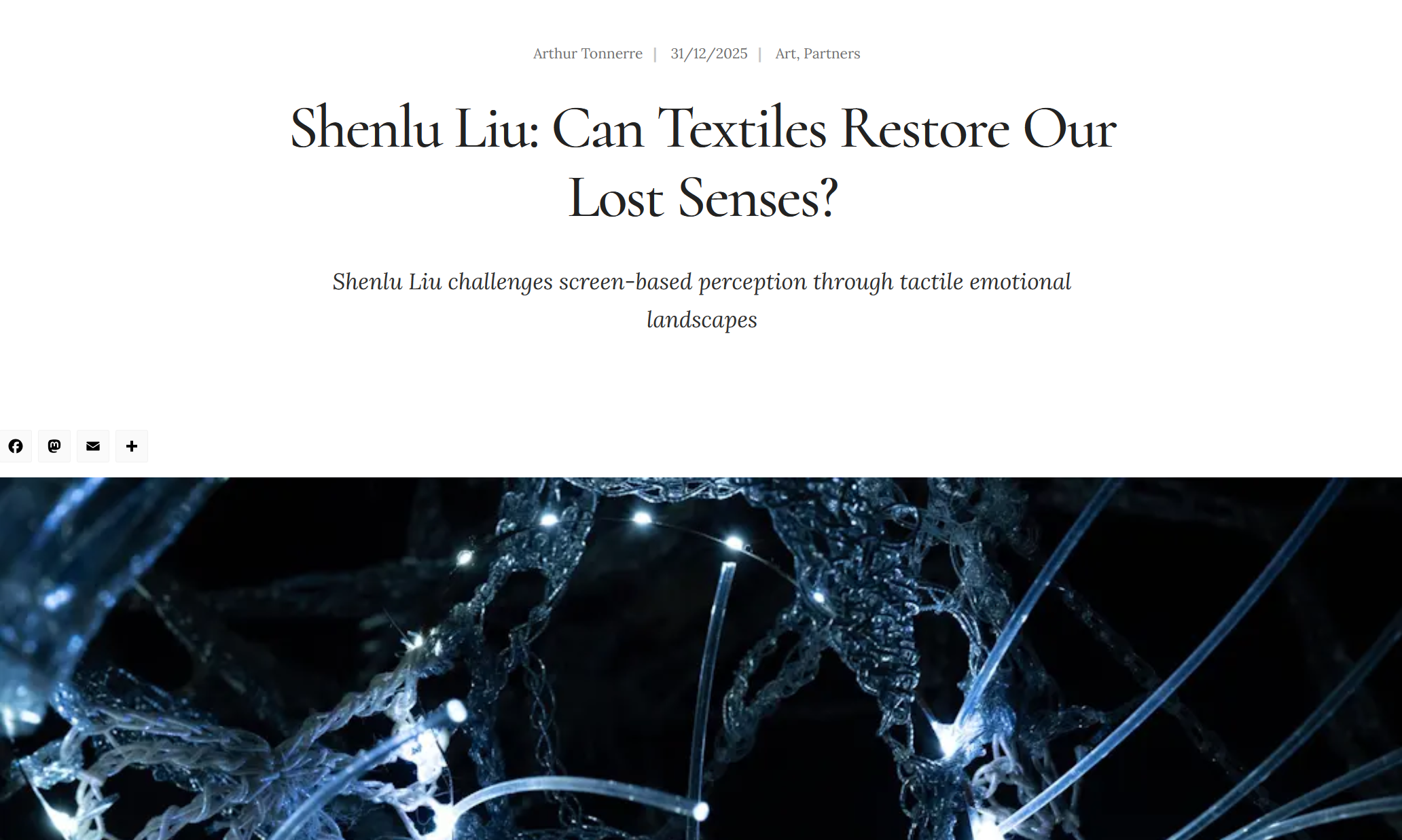
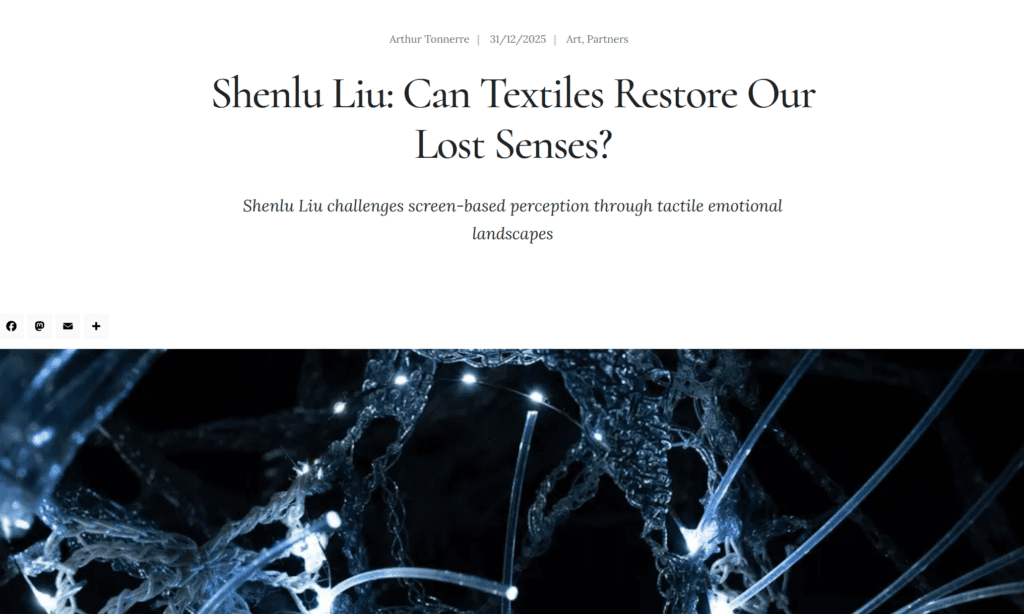
  • Shenlu Liu challenges screen-based perception through tactile emotional landscapes

    Shenlu Liu challenges screen-based perception through tactile emotional landscapes

    “After studying fashion and textiles, Liu graduated from the Royal College of Art in 2024, positioning her as an artist with a deep background in the materials she works with. Her practice has paradoxically tried to counter visual-led aesthetics with an appreciation for the role that other senses, particularly touch, play in how we construct our comprehension of the world (Liu, 2025). The paradox is that her work is strikingly visual, luminescent, stimulating, so the question is whether she is actually championing touch or whether, by revealing the operations of the non-visual in a visual way, she isn’t doubling down on the primacy of sight.

    Central to Liu’s work is what she considers a ‘crisis of perception’, the slow erosion of embodied experiences as contemporary life leans into virtualised, largely screen-based, flat visual symbols. In this view, the field of life has become a mediated intellectual exercise rather than one of resonant, critically physical, moments. Liu (2025) articulates this concern…”
    Read more

    Arthur Tonnerre -Shenlu Liu: Can Textiles Restore Our Lost Senses?
    Arthur Tonnerre -Shenlu Liu: Can Textiles Restore Our Lost Senses?
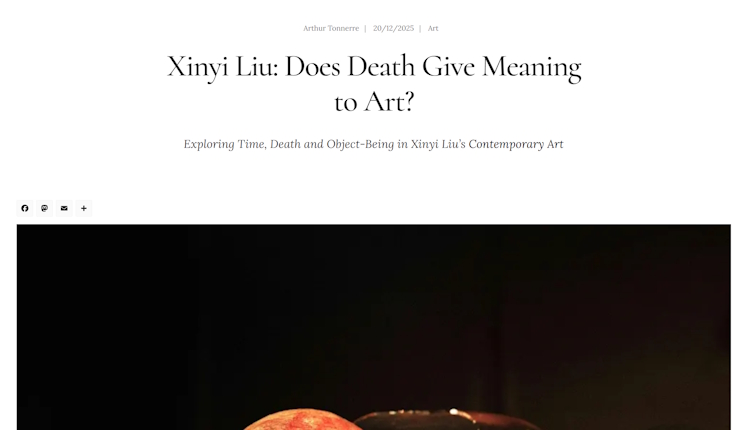
  • Exploring Time, Death and Object-Being in Xinyi Liu’s Contemporary Art

    Exploring Time, Death and Object-Being in Xinyi Liu’s Contemporary Art

    “In Liu’s artist statement, the auteurist nature of filmmakers Maya Deren and Park Chan-wook (Korean director of Joint Security Area, 2000 and Oldboy, 2003) appears perhaps as milestones in her growth as an artist. One can see traces of Deren’s avant-garde films in the way Liu’s work eschews narrative and tries to impart an experience of time and object in her practice. Deren herself sought to free herself from movie conventions in order to explore what critic John Martin called ‘choreocinema’, namely moving images that link the movement of beings with the profile (actual or imagined) of objects. A fluid exchange whereby moderns:

    “…discovered that that which seemed simple and stable is, instead, complex and volatile; its own inventions have put into motion new forces, toward which it has yet to invent a new relationship” (Deren 1984)

    This presents a slippery world where all things exist in a web of psychological or magical connections. The organic objects in Liu’s practice, things that resist ideas of fixity, work in the same vein. The separation between body and object is erased, making meaning flow both ways between subject and object.”

    Read more

    Arthur Tonnerre - Xinyi Liu
    Arthur Tonnerre – Xinyi Liu
  • Nadia Ryzhakova

    Nadia Ryzhakova

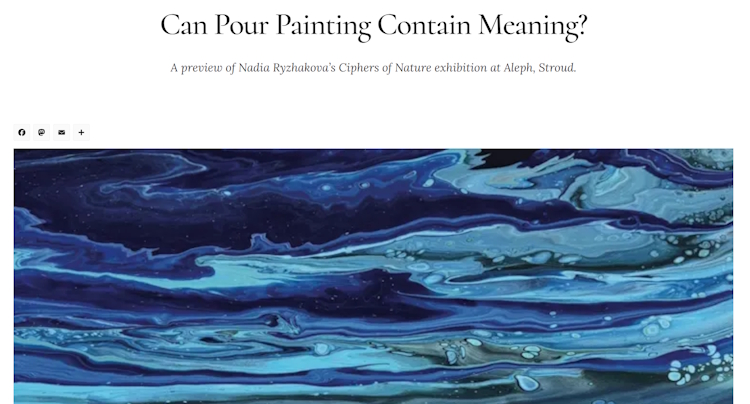
    A preview of Nadia Ryzhakova’s Ciphers of Nature exhibition at Aleph, Stroud.

    “The works explore hidden patterns in nature. Ryzhakova begins each painting by pouring liquid colour onto the canvas. Gravity, air and chance shape the paint. The results evoke river deltas, tree branches, cloud formations, moss textures.

    She refers to the Chinese concept of Li — inherent rhythms of leaf veins, water ripples, stone crystals. The move from chaos to order is central. Once the paint dries into one fixed surface, she steps in. She does not impose structure but translates what emerges. Often children appear in these scenes, representing curiosity and the capacity to see wonder in what others might call randomness.

    Each canvas is a journey from fluid formlessness to form, from abstraction to narrative. Viewers are invited to observe nature’s unseen forces and recognise in those patterns something universal and human.”

    Read more

    Arthur Tonnerre - Nadia Ryzhakova
    Arthur Tonnerre – Nadia Ryzhakova