Arthur Tonnerre

Art Journalist

Category: Art Writing

  • Nadia Ryzhakova

    Nadia Ryzhakova

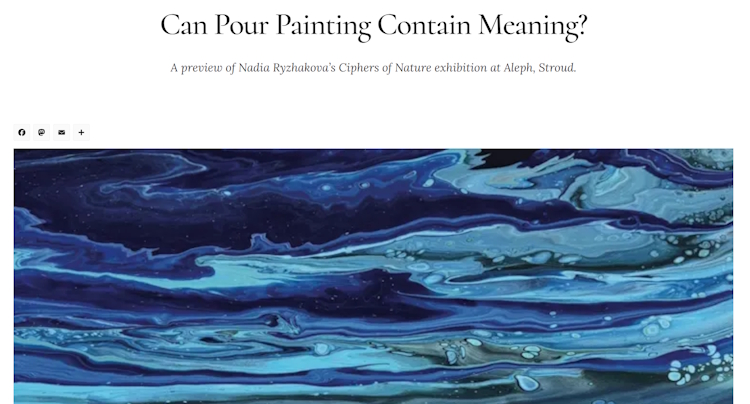
    A preview of Nadia Ryzhakova’s Ciphers of Nature exhibition at Aleph, Stroud.

    “The works explore hidden patterns in nature. Ryzhakova begins each painting by pouring liquid colour onto the canvas. Gravity, air and chance shape the paint. The results evoke river deltas, tree branches, cloud formations, moss textures.

    She refers to the Chinese concept of Li — inherent rhythms of leaf veins, water ripples, stone crystals. The move from chaos to order is central. Once the paint dries into one fixed surface, she steps in. She does not impose structure but translates what emerges. Often children appear in these scenes, representing curiosity and the capacity to see wonder in what others might call randomness.

    Each canvas is a journey from fluid formlessness to form, from abstraction to narrative. Viewers are invited to observe nature’s unseen forces and recognise in those patterns something universal and human.”

    Read more

    Arthur Tonnerre - Nadia Ryzhakova
    Arthur Tonnerre – Nadia Ryzhakova
  • Jon Dodd

    Jon Dodd

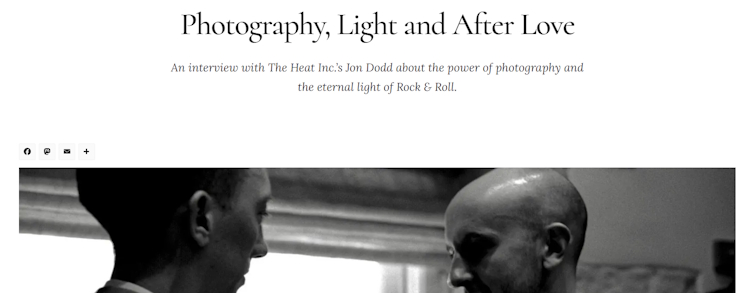
    An interview with The Heat Inc.’s Jon Dodd about the power of photography and the eternal light of Rock & Roll.

    What do you love about photography?

    For me, it’s always been about the ability to capture a moment in time and space. You listen to Asimov talk about it and he points out that before photography there might as well have been nothing. Nothing and no-one that we could see, at any rate.

    I mean sure, you have painting but who had their portrait painted before 1840? Kings, queens, the nobility, maybe a merchant or two but rarely a commoner. It was just too expensive. Too impractical. Plus, painting is a compromise at best. It’s not an accurate depiction of reality, whereas with the advent of photography, we finally had this tool, this incredible ability to make the world stand still.

    Polaroid photography is both a wonderful example and an exception because it’s an alchemical process of sorts, one that so beautifully straddles the line between art and science but it was designed and marketed to be available to everyone.

    Edwin Land was almost democratic, in a way. Everyone and their grandmother could take a picture and it would be an accurate, albeit painterly depiction of a moment in time. Actually, it’s not only a picture of a time and place and the people and objects therein but it’s also physically, necessarily from that point in time, which makes each and every one of them a special sort of artefact. It’s about making everything stop, just for a second and then being able to look back at that image and get a feeling or a memory by doing so. It’s about extrapolating meaning from the past.”

    Read more

    Arthur Tonnerre Jon Dodd
    Arthur Tonnerre Jon Dodd
  • Chus Martinez

    Chus Martinez

    Chus Martinez on Art as IntelligenceCuratorial Activism, and the Oracle of Democratic Possibility

    “Chus Martínez leads the Institute Art Gender Nature at FHNW Academy of Arts and Design in Basel. Born in Spain with a background in philosophy and art history, she has established herself as one of Europe’s most influential contemporary art curators and cultural theorists.

    Martínez served as expedition leader for The Current, a ground breaking project by TBA21–Academy from 2018 to 2020, and directed Ocean Space in Venice from 2020 to 2022. These oceanic initiatives inspired Art is Ocean, her ongoing seminar series examining artists’ roles in reconceptualising humanity’s relationship with nature. At her institute, she leads The Gender’s Factor, a research project investigating education’s role in advancing women’s equality within the arts.

    Her curatorial career spans major international institutions. She worked as chief curator at El Museo Del Barrio in New York and served as head of department for dOCUMENTA(13) in 2012. Previous positions include chief curator at MACBA Barcelona, director of Frankfurter Kunstverein, and artistic director of Sala Rekalde in Bilbao. She has curated national pavilions for Catalonia and Cyprus at the Venice Biennale and contributed to the Istanbul Biennial, Carnegie International, and Bienal de São Paulo.”

    Read more

    Arthur Tonnerre - Chus Martinez
    Arthur Tonnerre – Chus Martinez
  • Vesna Petresin

    Vesna Petresin

    Transdisciplinary artist who explored the fluid boundaries between consciousness, technology, and the future

    “The 36th Ljubljana Biennale of Graphic Arts has been dedicated to the Slovenian artist Dr Vesna Petresin (BSc PhD FRSA) who died in May 2025 on the eve of the biennale. According to Chus Martinez, biennale director, while suffering what would be the end of her fight with cancer, she oversaw the installation of her work and, signing it off, passed away days later. A multimedia artist of international renown, her final work encapsulates not just her career but also the themes of this year’s biennale. Making a poignant statement about the nature of utopianism, science and immersive consciousness, her piece asks us to consider our position as it relates to the future.

    The piece Autonomous Energy Machine (2025), created in collaboration with her father Prof Dr Eugen Petrešin (scientist, see details below), contains signature elements from her career: fluid dynamics, water, generative structures, energy and synaesthetic immersion. Many of these themes/subjects were rooted in both her academic background as a student but also her continued work as an educator. Her work, as for many artists, drew on the totality of her experiences: academic, aesthetic, musical, literary and of course that shadowy source, ineffable inspiration.”

    Read more

    Arthur Tonnerre - Vesna Petresin
    Arthur Tonnerre – Vesna Petresin
  • Biennale Gherdëina

    Biennale Gherdëina

    A review of Biennale Gherdëina 9: The Parliament of Marmots and GaMec: Thinking Like a Mountain. 2024 Italy.

    “Nestled in the midst of the Dolomites, in an autonomous community of Northern Italy, is art set in a dream? The Biennale Gherdëina is a precious event. The mere presence of fairy tale towns like Ortisei and Bergamo, set so precariously amid precipitous mountains, is a statement of humanity’s drive to escape and immerse itself in nature (if only to discover what it is to be alive). 

    2024 sees the ninth Biennale Gherdëina find guiding inspiration in the Ladin legend of the Fanes. The tale tells of a people cursed when they abandon their connection to their wild Marmot ancestors, eventually returning to live beneath the land until a portentous time of their re-emergence. “

    Read More

    Arthur Tonnerre - Biennale Gherdëina 9
    Arthur Tonnerre – Biennale Gherdëina 9
  • Kane & Able

    Kane & Able

    Comics and graphic novels: Is anyone pushing the edge of sequential art?

    Comicbook heroes are mainstream and big screen. They are the giant myths written across our lives. Run through with commercial hooks they would carry us blindly from purchase to purchase given half a pound. With an equal choice between two similar products who wouldn’t choose the one branded with greatness, the super product? 

    The once niche spandex-clad archetypes of Marvel and DC comics now function as central myths in Western society. Perhaps not as clearly as Churchill or Hitler but they are tools through which we work over our moralities, guiding principles, our societal trajectories. They comfort us with the idea of absolutes and the power of choice and, in doing so, infantilise us by appealing to our lowest and most servile instincts. They’re also damn good fun and allow us to break away from the lowest and most servile realities of contemporary life. An escape into the machine-language binaries of our reacting chimp and hungry reptile, emotional safe spaces of need-as-nobility (I need this for the good of humanity) and reward-as-satisfaction (closure achieved!).”

    Read more

    Arthur Tonnerre - Krent Able
    Arthur Tonnerre – Krent Able
  • Julie Alf – Enter Art Fair

    Julie Alf – Enter Art Fair

    Trebuchet interviews Enter Art director Julie Alf about the inspiration behind the fair.

    “Building on a mission to create a forum for new and experimental artists, art commercial and education, Enter Art Fair Director Julia Alf, has proven that there is space for new fairs in the busy schedule of international events. Chatting with Trebuchet, we wondering where her love of art comes from and what inspires her to this day.

    She has made lifestyle fairs for over 20 years, focusing on art fairs for the last 10 years and started the art fair Code Art Fair in 2016 under the direction of the Bellacenter in Copenhagen. She became a self-employed entrepreneur and in 2019 founded Enter Art Fair with a handful of art-lovers. But what inspired her at the beginning;

    “My first art fair experience was with the Danish art fair Art Copenhagen. The fair was located in the venue Forum in Copenhagen, where I was the sales manager. I was in charge of all the fairs in Forum including Art Copenhagen.”

    Read more

    Arthur Tonnerre - Enter Art Fair
    Arthur Tonnerre – Enter Art Fair
  • Emma Coyle

    Emma Coyle

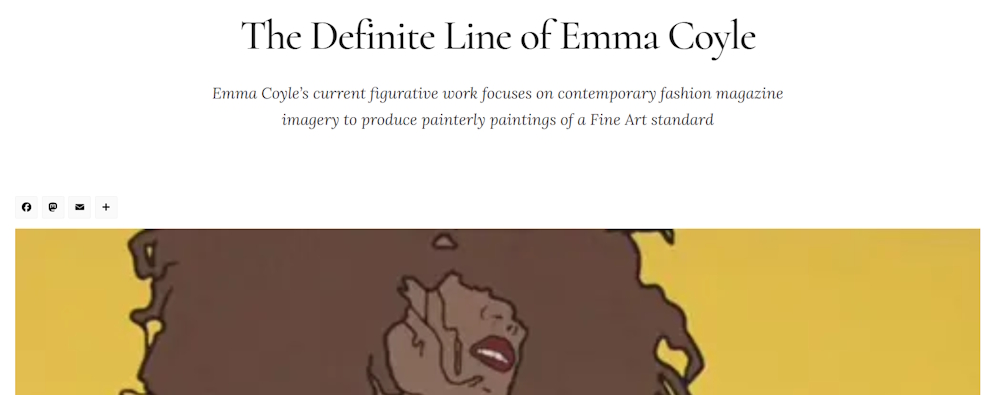
    Emma Coyle’s current figurative work focuses on contemporary fashion magazine imagery to produce painterly paintings of a Fine Art standard

    “For over 20 years artist Emma Coyle has embarked on a personal journey of figurative art. Based in London since 2006 she has received the International Art Market’s Gold List award named as ‘Top international contemporary artist of today’, ‘Recommended artist to invest in and to be inspired by’ and whose work has been acquired by Dame Janet Wolfson de Botton.

    Coyle’s first education in art in the 1990s included an introduction to 1st wave New York Pop Art of the 1950s. Her current figurative work focuses on contemporary fashion magazine imagery to produce painterly paintings of a Fine Art standard. Combining primary and secondary line work with ideas in abstraction, minimalism, and negative space.”

    Read more

    Arthur Tonnerre - Emma Coyle
    Arthur Tonnerre – Emma Coyle
  • Thomas Huber

    Thomas Huber

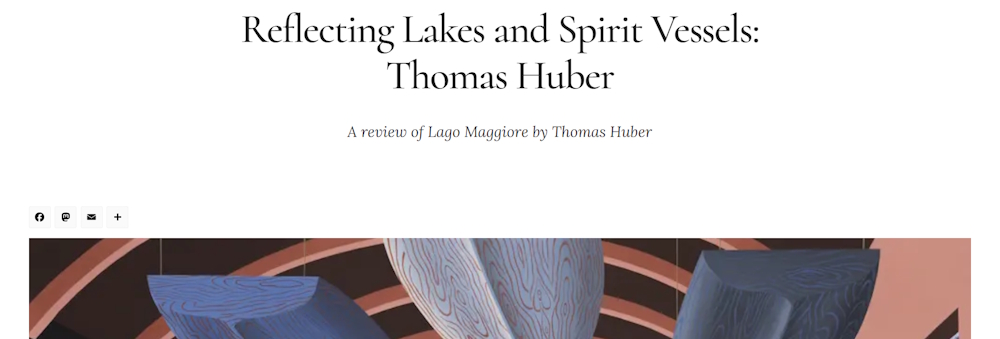
    A review of Lago Maggiore by Thomas Huber

    “Thomas Huber’s works express the immanence of spaces. Many of his earlier works contained rooms or architectural constructs that assumed both a distance from the viewer and a vivid space, creating their own contextual relations. The space is characterised by symbolic elements and positions that convey a separate reality, detached from our familiar associations. Examining his earlier works reveals the subjectivity of these settings. Different elements shape and serve as vessels of meaning, creating a clamour of dislocated moments, compelling closer inspection due to their distance from the viewer’s immediate position.

    Huber’s movement from these earlier works, reminiscent of the brooding architectural sentiment in Giorgio De Chirico’s metaphysical works, towards his 2023 show Lago Maggiore marks a significant development. In the work Heimkehr (2021), we witness a continuation of his previous approach, which appreciates his new location around Lake Lugano. Huber has remarked that his works are intrinsically linked to the material, physical, and cosmological elements of the lake. Its light and the sensual movement of its surface are embodied in the artwork. However, the overarching symbolism of the elements signals the end of something, a death, while also alluding to something beyond.”

    Read more

    Arthur Tonnerre - Thomas Huber
    Arthur Tonnerre – Thomas Huber
  • Fanglin Luo

    Fanglin Luo

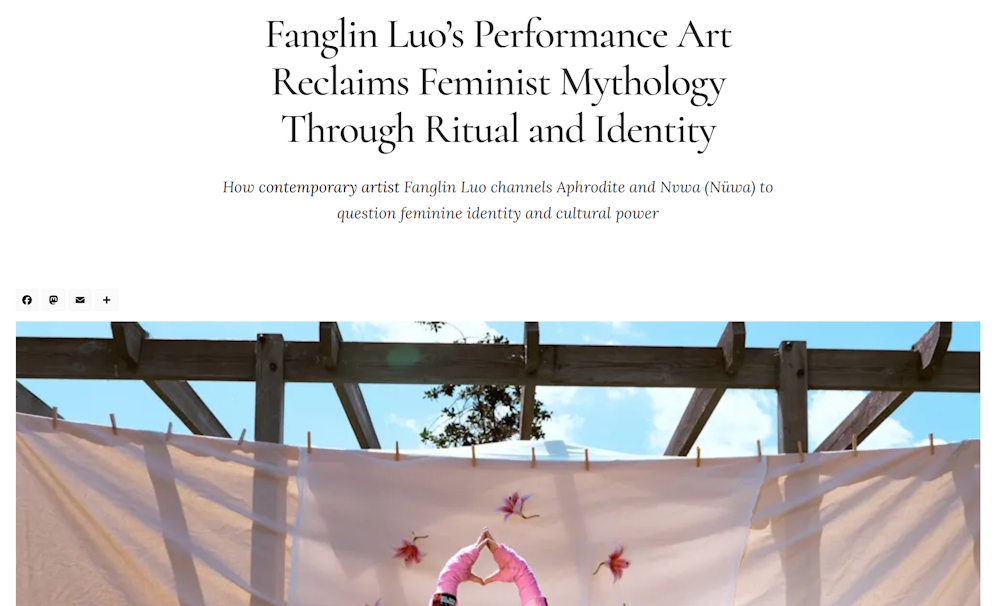
    How contemporary artist Fanglin Luo channels Aphrodite and Nvwa (Nüwa) to question feminine identity and cultural power

    “hrough the lens we see a dancer in front of a fence. There is a wind-tussled sheet hanging behind her. The sound of crashing waves intensifies as the dancer starts to rise from a crouch and into a series of movements, sometimes balletic, sometimes frantic. On the sheet a circle of flowers moves with quick balletic movements. Part performance, part statement, there is something here that is struggling to be understood. Is this itself the message?

    Multidisciplinary artist Fanglin Luo’s work takes viewers on a broad journey through ritual femininity and exploratory performance art. These are universal themes that she interprets through performance works that restage powerful cultural archetypes as a form of resistance against patriarchal tropes. But history has deep roots and not all of them bear sweet fruit. The question viewers face is whether her myth (re)making marks true growth.”

    Read more

    Arthur Tonnerre - Fanglin Luo
    Arthur Tonnerre – Fanglin Luo
  • Dürer to Warhol

    Dürer to Warhol

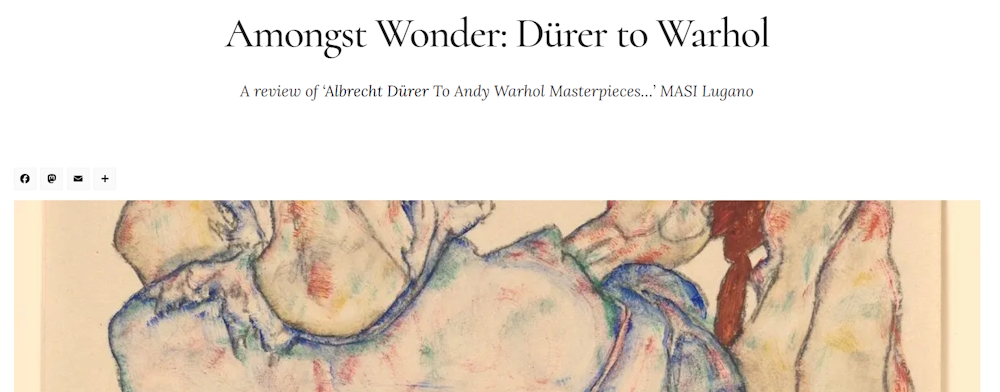
    A review of ‘Albrecht Dürer To Andy Warhol Masterpieces…’ MASI Lugano

    “Amidst the diversity of the showcased works, some spectators may be lured into issuing grandiose proclamations on the pivotal role of print reproduction within the annals of art history. However, this exhibition transcends the mere thematic or physical consolidation but unfolds as a rare juncture inviting an immersive plunge into the profundity of genius, casting shadows potent enough to obscure the aspirations of contemporary and future art.”

    Read more

    Arthur Tonnerre - Dürer & Warhol
    Arthur Tonnerre – Dürer & Warhol
  •  Jamieson Webster

     Jamieson Webster

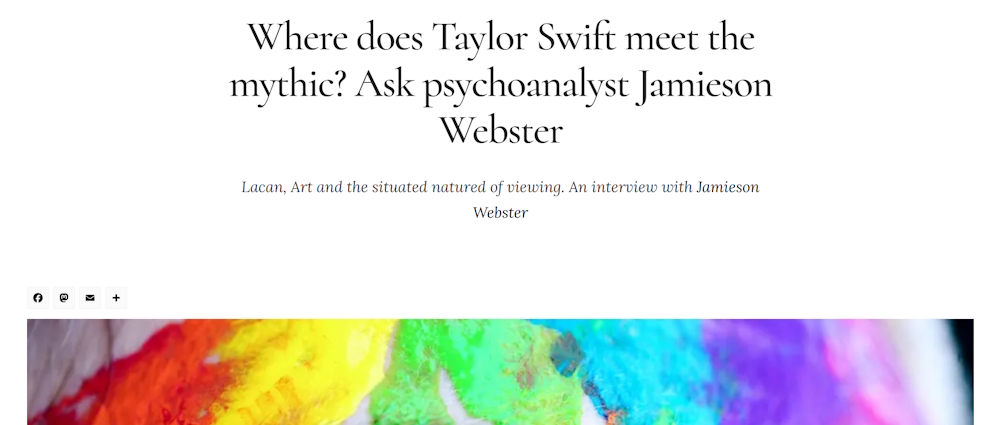
    Lacan, Art and the situated natured of viewing. An interview with Jamieson Webster

    “It’s complicated. Because I feel with each artist, I do something different. I’m a writer, and a psychoanalytic theorist, and I am a professor at The New School. So on the one hand I work theoretically and then on the other hand, I have a clinical practice and a clinical ear. It’s a combination of the two that I bring to the table but I feel that with every artist something different comes up. In my mind it’s not that I psychoanalyse the artists, rather I do something different with each one.”

    Read more

    Arthur Tonnerre - Jamieson Webster
    Arthur Tonnerre – Jamieson Webster
  • Folkestone Trienniale

    Folkestone Trienniale

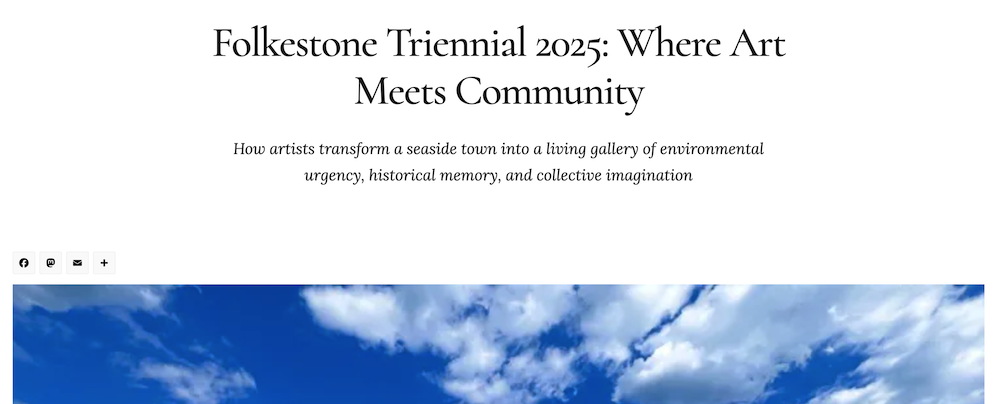
    How artists transform a seaside town into a living gallery of environmental urgency, historical memory, and collective imagination

    “Their vision of the festival marries contemporary concerns with artistic flourish and remains true to the idea of ‘treating the town like a gallery’. One of the most interesting aspects of Folkestone is how artists embed their works within the town’s context. Where we expect to see artworks in the white cube of the gallery experience, here the locations and their discovery reverberate with power that imparts a sense of magical realism. The expected world redevelops into perfect settings for artistic vision. Often it takes the form of subtle language or communication; the act of walking and discovering each location assumes a potent frequency. While it remains possible to reduce each artwork by intention and execution, the overwhelming installation feeling of the triennial lingers with visitors. All artists attempted location-based work that used the symbolism of their settings to create an immanent frame for what they wanted to convey.”

    Read more

    Arthur Tonnnerre - Folkestone Trienniale 2025
    Arthur Tonnnerre – Folkestone Trienniale 2025
  • Jingjing Xu

    Jingjing Xu

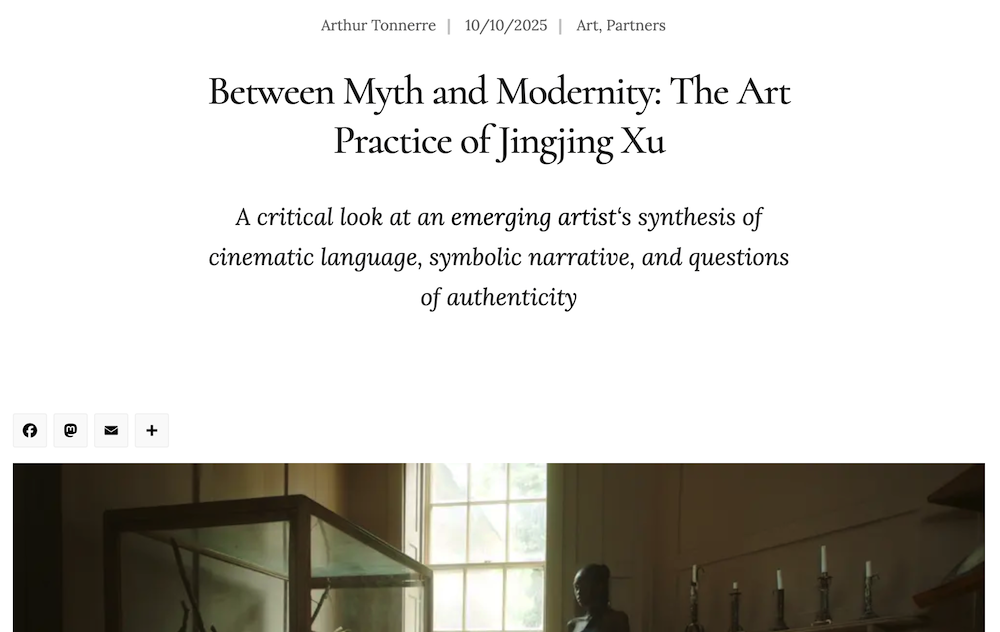
    A critical look at an emerging artist‘s synthesis of cinematic language, symbolic narrative, and questions of authenticity

    “This generation of artists also encourages reflection on how they differ from their predecessors. Figures such as Nam June Paik, Cindy Sherman, Bill Viola and Dara Birnbaum once examined the materiality of media from a McLuhanesque perspective, questioning what television is, what cinema can do and how media shape consumption. In contrast, contemporary artists like Xu employ cinematic language with native fluency. Having grown up in an era defined by memes, social media and promotional imagery, they create within a visual vocabulary already saturated with commercial aesthetics, auteur cinema and representational ideology.”

    Read more

    Arthur Tonnerre - Jingjing Xu web
    Arthur Tonnerre – Jingjing Xu web
  • Simon Tayler

    Simon Tayler

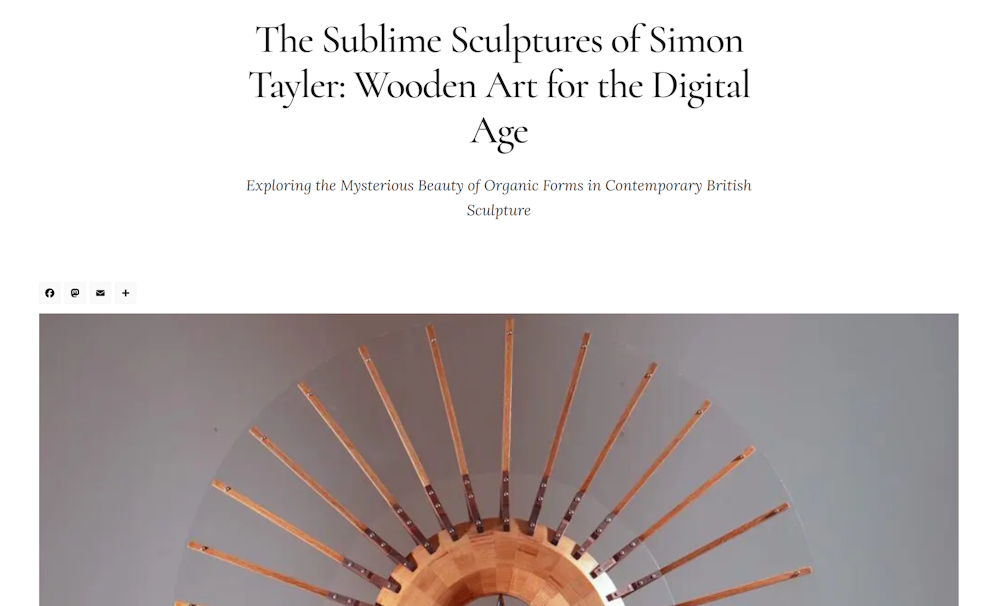
    Exploring the Mysterious Beauty of Organic Forms in Contemporary British Sculpture

    “Tayler’s practice explores the delicate threshold between the organic and the mechanical, the stable and the unstable, the material and the imagined. Working primarily in wood, he employs an incremental, mathematical process of construction—each adjustment dictating whether a curve extends outward or folds back upon itself. The resulting forms are intricate, fluid, 2 and 3 dimensionally charged with a quirky naturalism.

    In Flux, these curving trajectories become metaphors for states of mind: thoughts that cohere with clarity, or else knot and tighten under tension. Tayler’s sculptures are grounded by their points of contact with the floor or wall, yet they seem to listen, transmit, and extend beyond themselves—as if mediating between the inner and outer world.”

    Read more

    Arthur Tonnerre - Simon Tayler - Art Criticism
    Arthur Tonnerre – Simon Tayler – Art Criticism
  • Milan 2025

    Milan 2025

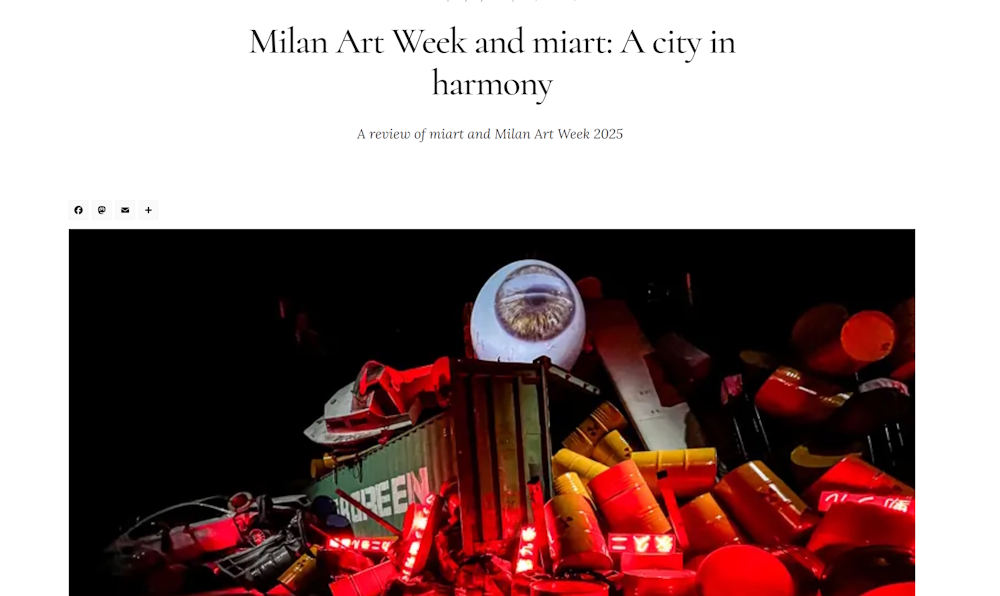
    A review of miart and Milan Art Week 2025 

    “For the 2025 edition Rauschenberg isa pivot point for showcasing both painting and multimedia art, the link between modernist art of the 1940s and the individuation which franks contemporary art. Mixed media and conceptual, there are a lot of signifiers in Rauschenberg’s works that anticipated where art would eventually move and several galleries around Milan are showcasing his works as if they were created yesterday. As a celebration of his centenary year the 2025 ninth edition of miart assembles museum exhibitions, talks and projects reflecting Rauschenberg’s ahead-of-his-time commitment to collaboration and syncretic ideas. The fair’s theme of ‘among friends’ projects this with galleries and institutions working together to enhance the city’s vision for artistic re-growth. A vision that’s coming into sharp focus in 2025, with highlights including John Giorno at the Triennale di Milano (until 14 April), Typologien at Fondazione Prada (14 June), the portal section of the miart (6 April), Nico Vascellari’s Pastoral at Palazzo Reale (2 June) and both Yukinori Yanagi and Tarek Atoui at Pirelli HangarBicocca (27/20 July). “

    Read more

    Arthur Tonnerre - Amsterdam Art Week 2025
    Arthur Tonnerre – Amsterdam Art Week 2025
  • Amsterdam 2025

    Amsterdam 2025

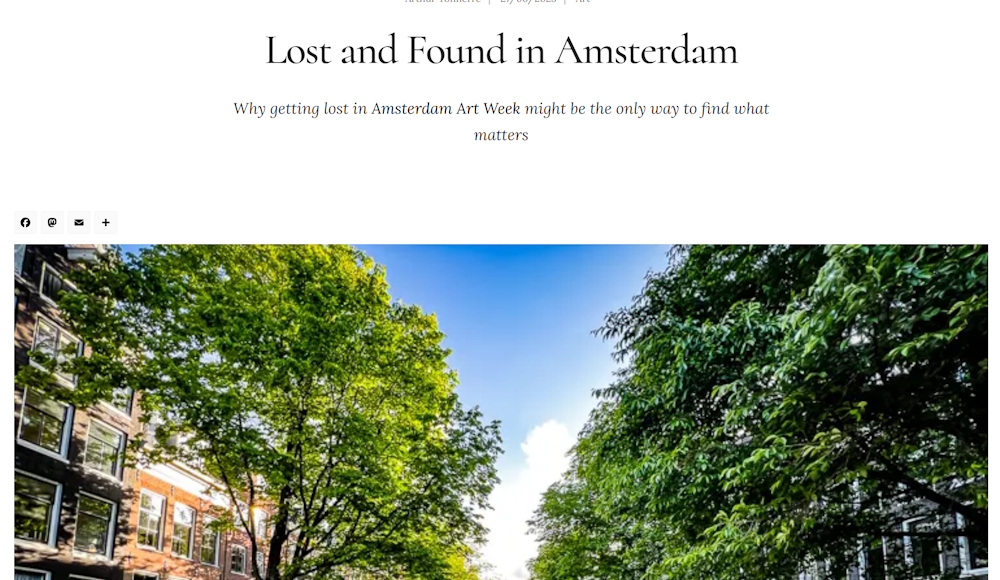
    Why getting lost in Amsterdam Art Week might be the only way to find what matters

    Amsterdam Art Week crystallises this experience across the phases of the day, from the sunlit work of the Rijksakademie, to the afternoon glamour of the major gallery shows, and trailing off with the personal delights of night-time rambles through the central district with this plethora of small galleries tempting the passer-by with window displays of restrained promise. It’s within the specificities of each moment that we can approach the larger questions: what makes Amsterdam a good site for art? 2025 is a political year so how is that reflected in Amsterdam’s art? Signs of growth, signs of life? What’s next?”

    read more

    Arthur Tonnerre - Amsterdam
    Arthur Tonnerre – Amsterdam
  • Wanting Wang

    Wanting Wang

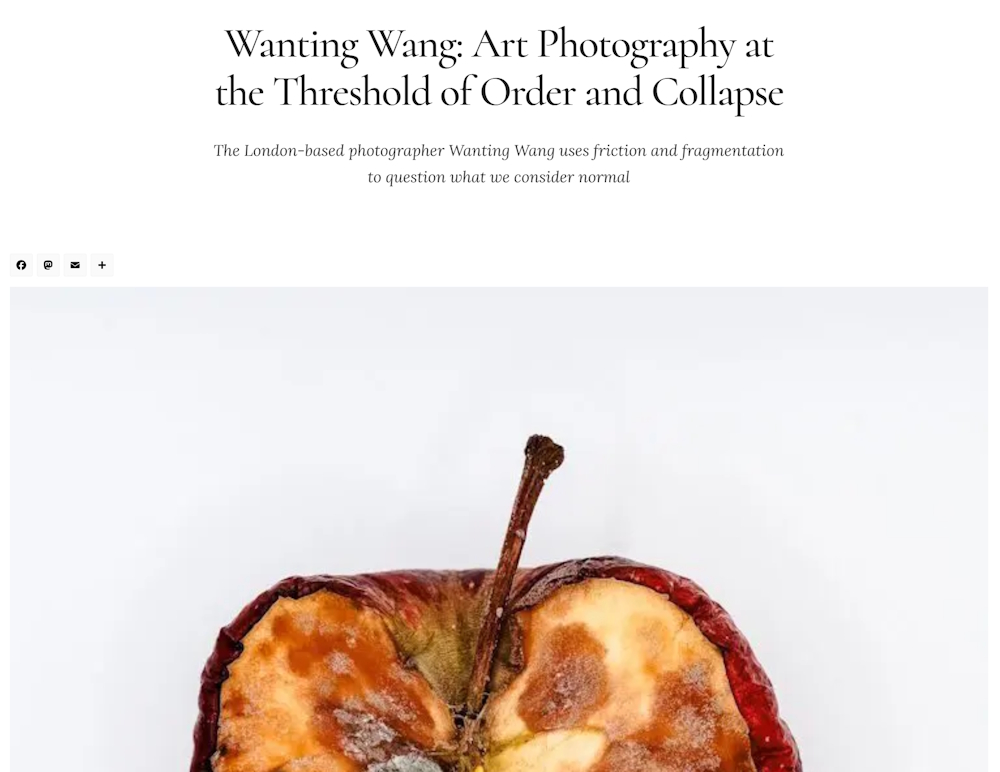
    The London-based photographer Wanting Wang uses friction and fragmentation to question what we consider normal

    “The influence of Sarah Lucas and Mona Hatoum hovers over Wang’s visual language, though the connection is conceptual rather than stylistic. Both artists transformed domestic objects into sites of strangeness and political charge, a quality that resonated deeply with Wang when she first encountered their work during her studies at the University of the Arts London. Reflecting on that encounter, she recalls, “The domestic was no longer soft or safe, it was charged, strange, and political. That tension stayed with me.” This awakening manifests throughout her practice, where familiar objects and environments are rendered unsettling through careful displacement and visual intervention.”

    read more

  • Paul Sietsema

    Paul Sietsema

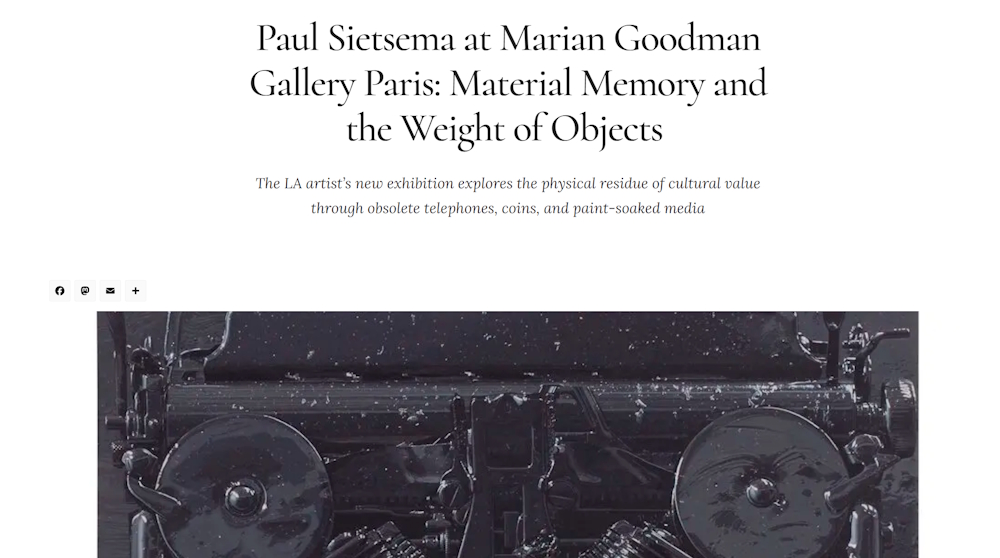
    Preview article on exhibition by Paul Sietsema

    “Sietsema’s current exhibition at Marian Goodman Gallery demonstrates this practice in full maturity. The new works on the ground floor (with their unplugged rotary telephones and paint-soaked CDs) exist as archaeological artefacts of our own recent past, whilst the earlier pieces in the basement reveal the artist’s commitment to excavating the material memory embedded in cultural objects. Together, they confirm Sietsema as one of contemporary art’s most rigorous investigators of how meaning accretes through the physical residue of use, time, and exchange. In an era defined by the dematerialised circulation of images, his insistence on the thereness of objects (their weight, their decay, their indexical traces) offers a counterpoint, reminding us that even in reproduction, something material remains.”

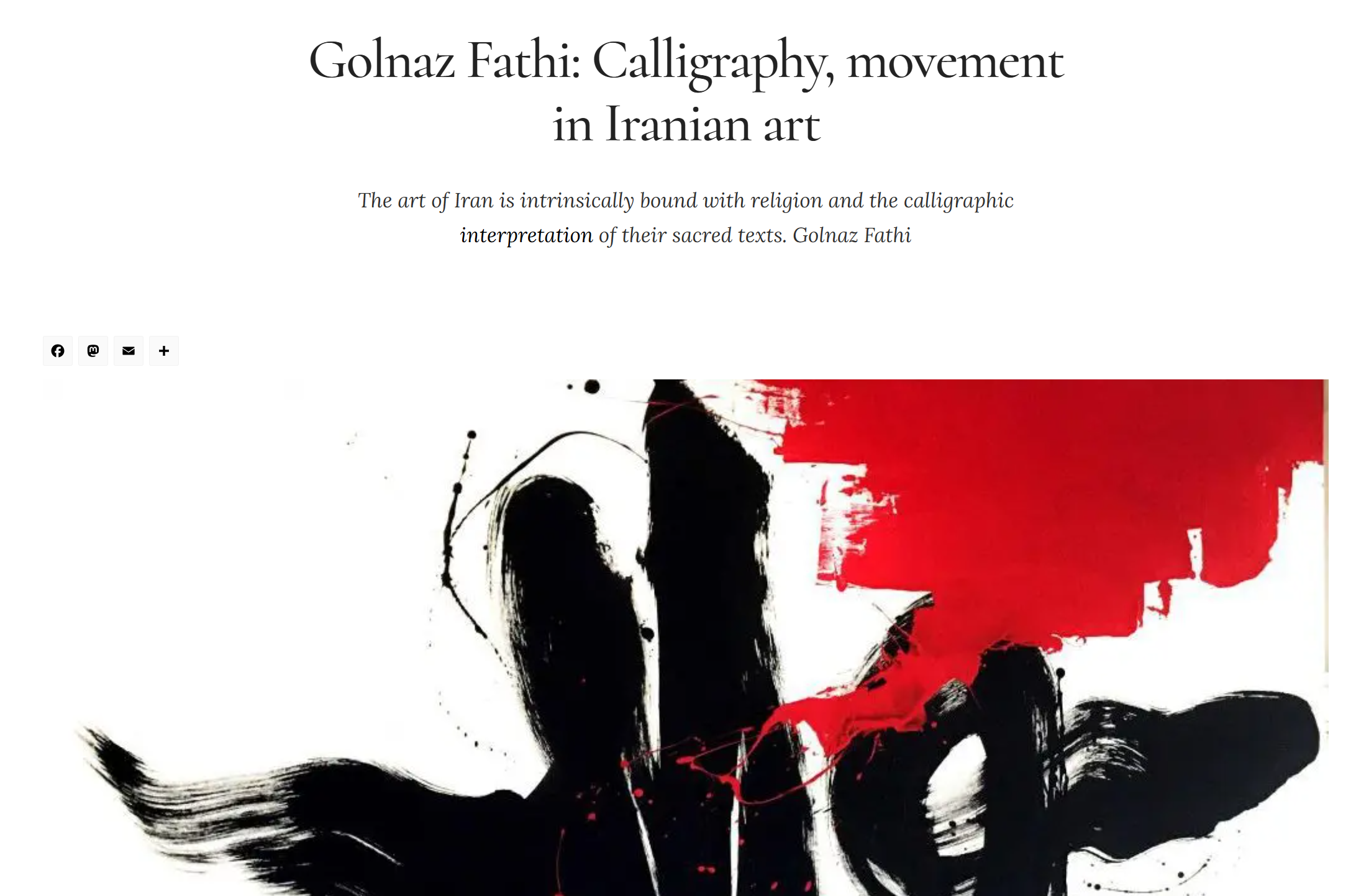
  • Golnaz Fathi

    Golnaz Fathi

    An article on Iranian artist Golnaz Fathi.

    Excerpt online full article in print.

    What attracted you to calligraphy? What about it do you find so expressive?

    For discovering calligraphy, I am thankful to my father: one summer at the age of 14 he took me, my sister, and a few of our friends to the calligraphy association in Tehran for the two months of summer classes. His aim was that we would have nice handwriting and in future that would help us a lot if we wanted to get a job—he never knew that there would be computers and we won’t fill out the applications by hand to [need to] have this priority to have nice handwriting! I fell in love with calligraphy in the first section and I was the only one who continued it. For me it was purely a meditation; when I was practicing, I wasn’t in this world, my body was here but my soul somewhere else. This love was that strong that it made me continue professionally in the highest level. I think calligraphy is spiritual and mystical; it’s a kind of deep meditation which needs a lifetime practice.”

    Golnaz Fathi: Calligraphy, movement in Iranian art
The art of Iran is intrinsically bound with religion and the calligraphic interpretation of their sacred texts. Golnaz Fathi

  • Art Writing by Arthur Tonnerre

    Art Writing by Arthur Tonnerre

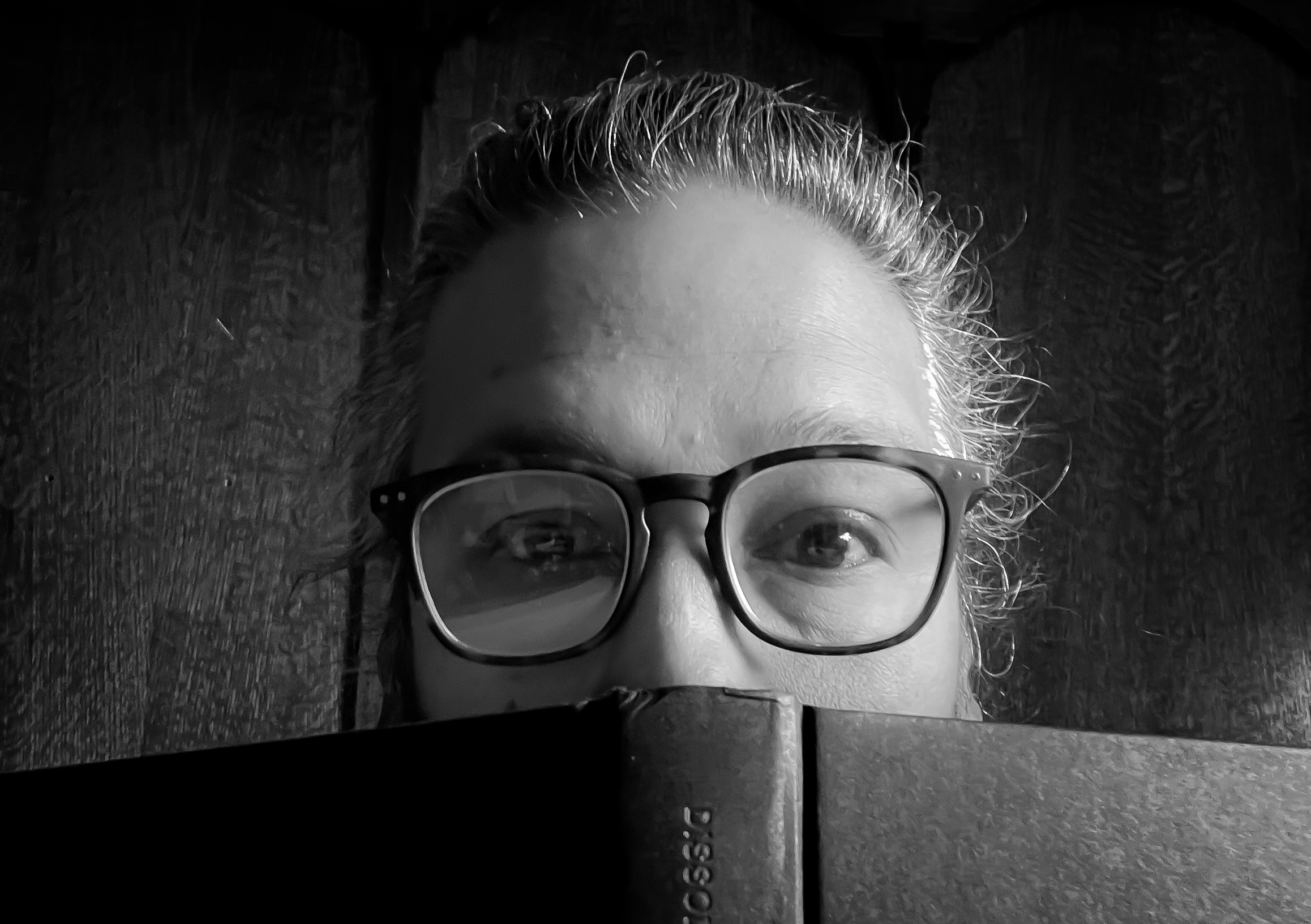
    This is a blog for the articles and essay by Trebuchet writer Arthur Tonnerre

    About me:
    Sometime-London based reader of art and culture. LSE Masters Graduate. Arts and Culture writer since 1995 for Trebuchet. Future Publishing, Conde Nast, Wig Magazine and Oyster. Specialist subjects include; media, philosophy, cultural aesthetics, contemporary art and French wine. When not searching for road-worn copies of eighteenth-century travelogues he can be found loitering in the inspirational uplands of art galleries throughout Europe.

    I’ll post links here but you can read the full length pieces at Trebuchet Magazine